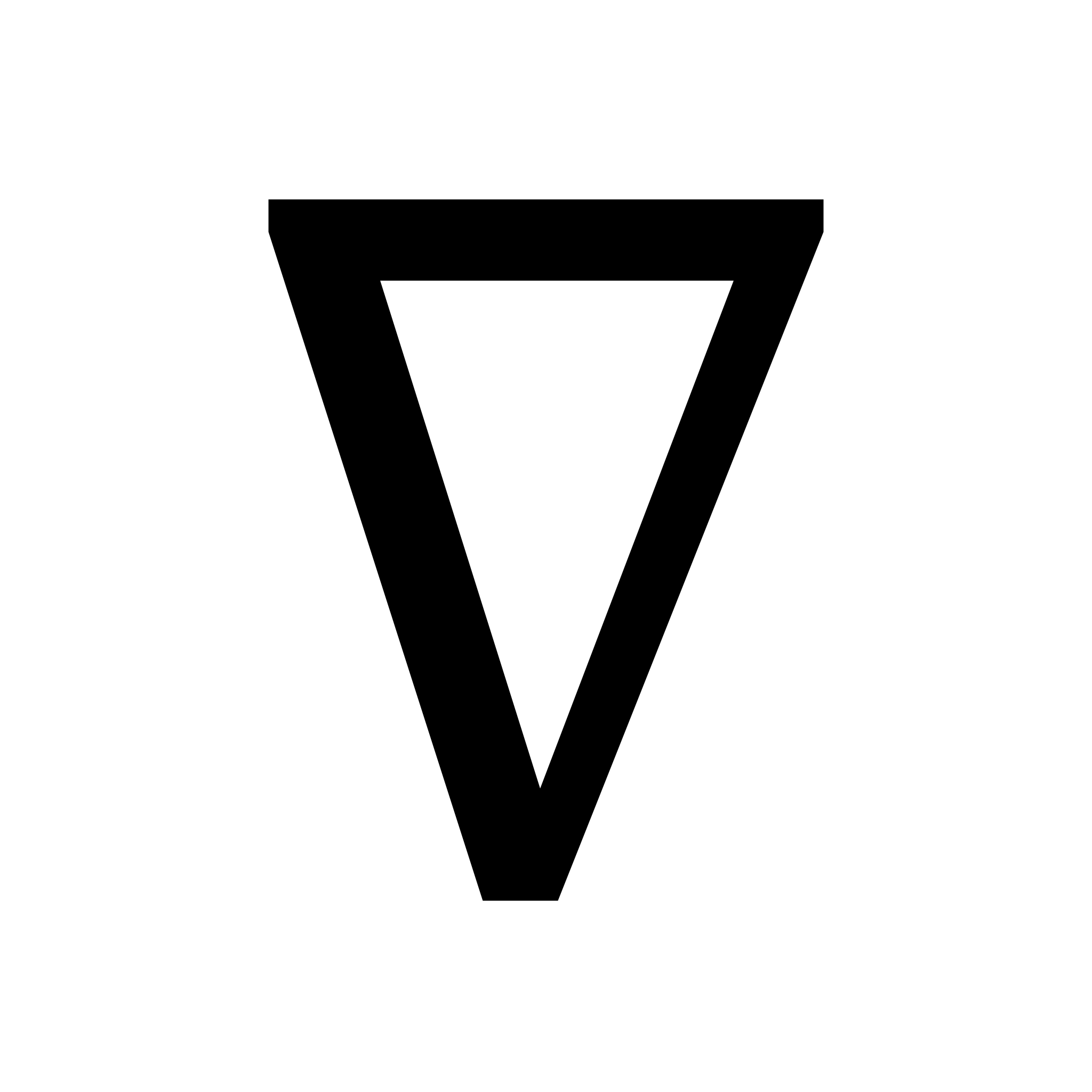
My math friend once told me that I didn’t know what integration was until I took measure theory. “Measure theory?” I asked, perplexed – “what does functions on sets have to do with integration?” Turns out, assigning a “mass” to each set and then integrating sideways generalizes the notion of an integral on the real line.
In the same vein, you don’t know what a derivative is until you’ve slogged through a bit of differential geometry.
I think everyone a priori is aware that something fishy is going on with how differential geometry works – for me, I used to enjoy going down wikipedia rabbit holes about advanced topics in physics and math, just to marvel at the fact that there are individuals alive who can understand and parse through all this. On one of these nights, I couldn’t help but notice that a lot of the equations used in General Relativity use the partial derivative of… nothing? Here’s just one example (this is the definition of the (affine) connection coefficients on a manifold):
$$
\nabla_{\partial_i} \partial_j = \Gamma^{k}_{ij} \, \partial_k.
$$
The gradient of a partial derivative? And what is a subscript partial derivative? I had to know – what in the world could the gradient of a partial derivative equalling something times the partial derivative of nothing have to do with how gravity works?
A manifold \( M \) of dimension \( m \) is a topological space together with a local homeomorphism \( \varphi : M \to \mathbb{R}^m \) – for the uninitiated, this means that a manifold is a surface that looks flat if you zoom in enough. Many new students of differential geometry focus their attention on the “flatness” because the word “homeomorphism” is new to them, when really they should be focusing on the “topological”-ness – its great and all that \( M \) is locally flat, but what differentiates the study of manifolds from the study of surfaces is that when you are on a manifold, that is all you are allowed to consider. There is no “outside” the manifold, no “inside” – in fact, its a topological space – there is no coordinate frame to tell you where you even are on the manifold (all you know is what subsets of the manifold are open or closed). This is quite limiting and frustrating, especially when you want to start defining tangent vectors on \( M \).
The problem is a little more subtle than it seems at first, because we have become so used to thinking of tangent lines and planes of surfaces as spaces that touch the surface at a point and (locally) one point only. But when you can only consider points on the manifold, this picture falls apart, because there is no notion of “away from” the surface, and so vectors in a tangent plane of a surface would have to leave the surface, without being allowed to think ab what “leaving” it means.. Hang on, what does it mean for a vector to “leave” the manifold anyways? Vectors are arrows with a direction and magnitude, but neither of these are tangible, concrete properties (like mass, or color would be), so how are we even saying the vector is “leaving” the manifold?
Maybe your first reaction (like mine) was to say, ok, lets define a tangent vector as the time derivative of a curve whose image is in the manifold. But this doesn’t address the problem: a derivative at a point is a local linear approximation – away from the point at which you are differentiating, your vector no longer is “on” the manifold – unless the manifold is globally flat it necessarily has to leave it, whatever that means.
In multivariable calculus we learn that vectors are always anchored at the origin but we can “imagine” them to be anchored at other places in \( \mathbb{R}^3 \) so that they represent different things (like velocity or acceleration of a particle). What my professor (shoutout prof. Youngren, one of the finest lecturers I’ve ever had) at the time was trying to get at is that at each point in space, we imagine a tangent vector as living in a copy of \( \mathbb{R}^3 \) that exists alongside our position vector, in another universe completely separate from ours. In differential geometry, we take this concept and we run with it – we say that a tangent vector is an element of a copy of (in a space linearly isomorphic to) \( \mathbb{R}^m \) that exists in a sort of parallel universe to our own.
(post in progress)
Leave a Reply